


Hi,
Since I started this podcast, I’ve become really interested in the gaps:
the gaps between how people appear to be coping and what’s really happening underneath,
the thoughts that we don’t say out loud and the ones that we keep returning to again and again,
and the ideas that we’ve spent a whole life learning only to want to unravel them when we realise they were never ours in the first place.
I think most of us live in those gaps more than we realise. Between being okay and not quite okay. Between who we are and who we think we should be. Between what the world rewards and what actually feels true for us. They can be uncomfortable places, but they’re also where so much honesty, creativity, self-trust and acceptance begin.
That’s why I’m so excited to share this week’s conversation, because so much of it lives in those in-between spaces. It’s about the gap between being good and being whole, between conditioned pleasing and genuine kindness, between the version of you that learned how to shrink and the version that’s now taking up the space (albeit a messier one) to just be.
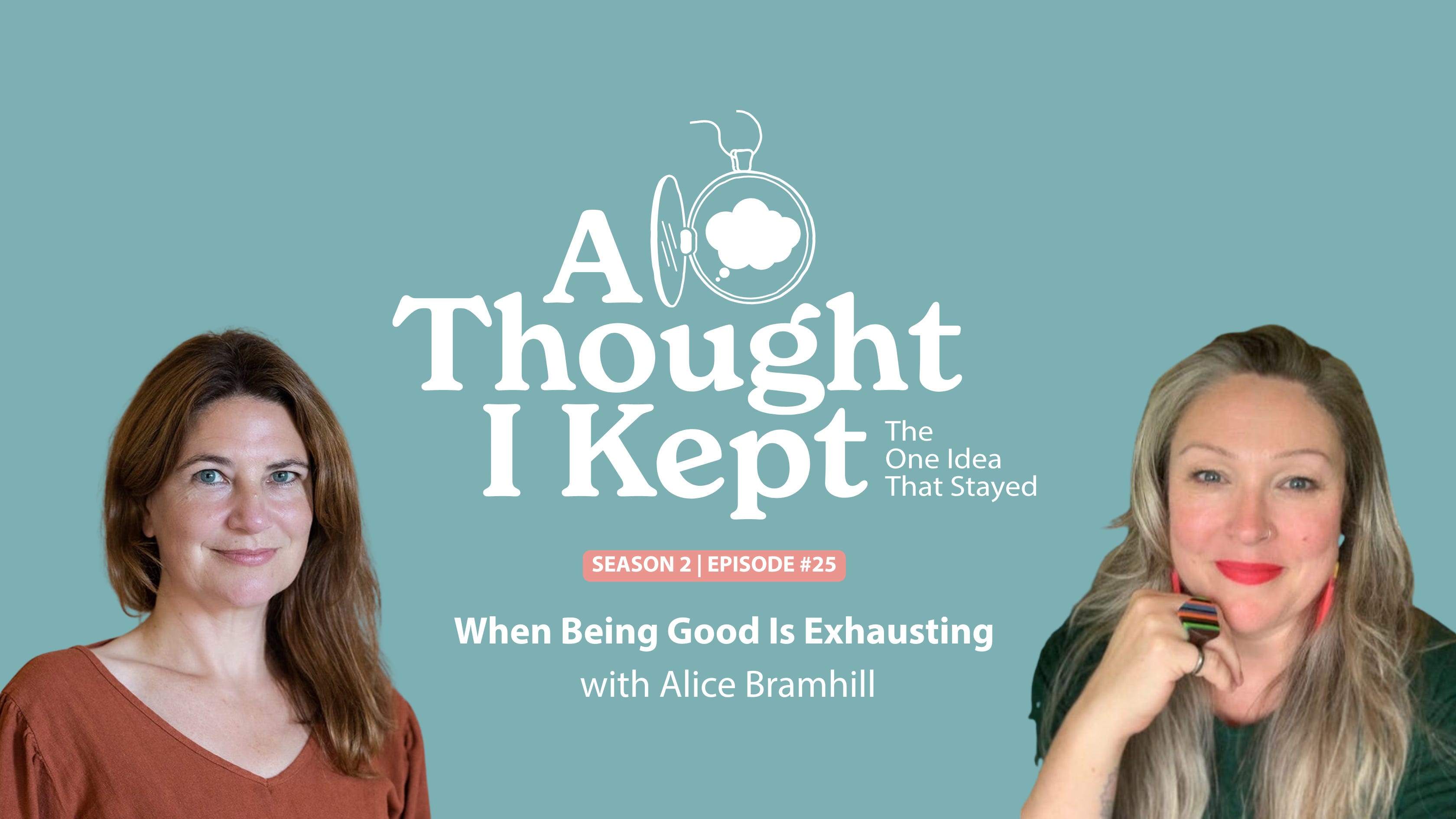
I’m talking to someone who for me brought so much nuance — and with that so much, somewhat counterintuitively, clarity — about how I show up in the world, how my mind works and how I relate to others and that’s Alice Bramhill. Alice is such a delightful human being. Talking to her on the show, I appreciated so much her generosity, her kindness, her warmth and her knowledge.
Alice, if you don’t know her, is a registered mental health nurse, psychotherapist, coach, and writer. Alice is the person behind the podcast and Substack, For the Deep Feelers and Big Hearted People-Pleasers.
I often find myself reading or listening to Alice, or scrolling her inspiring Instagram account as well, because there’s so much there that I want to understand about sensitivity and rejection and relationships and feelings and having a neurodivergent brain.
I also can’t wait to read Alice’s first book that pulls it all together, I Need My Space, But I Like You Too. It’s coming out in September and is available for pre-order now.
In this conversation, we explored what it means to discover yourself later in life and realise that you were never broken in the first place. We talk about people pleasing and the fawn response, the slow, often messy process of becoming visible, and what assumptions, other people’s and our own, have to do with any of it.
If you know Alice’s work already, I hope that you enjoy getting to know her a little bit more. And if Alice is someone who is new to you, I am envious that you are stepping into her world for the first time.
Listen to the episode here and discover the thought that Alice has kept over decades. It’s one that has helped her better understand herself and something she regularly offers to her clients.
Have a listen and let me know what this week’s thought kept means to you and how you might try it on in your own life.
x Claire


